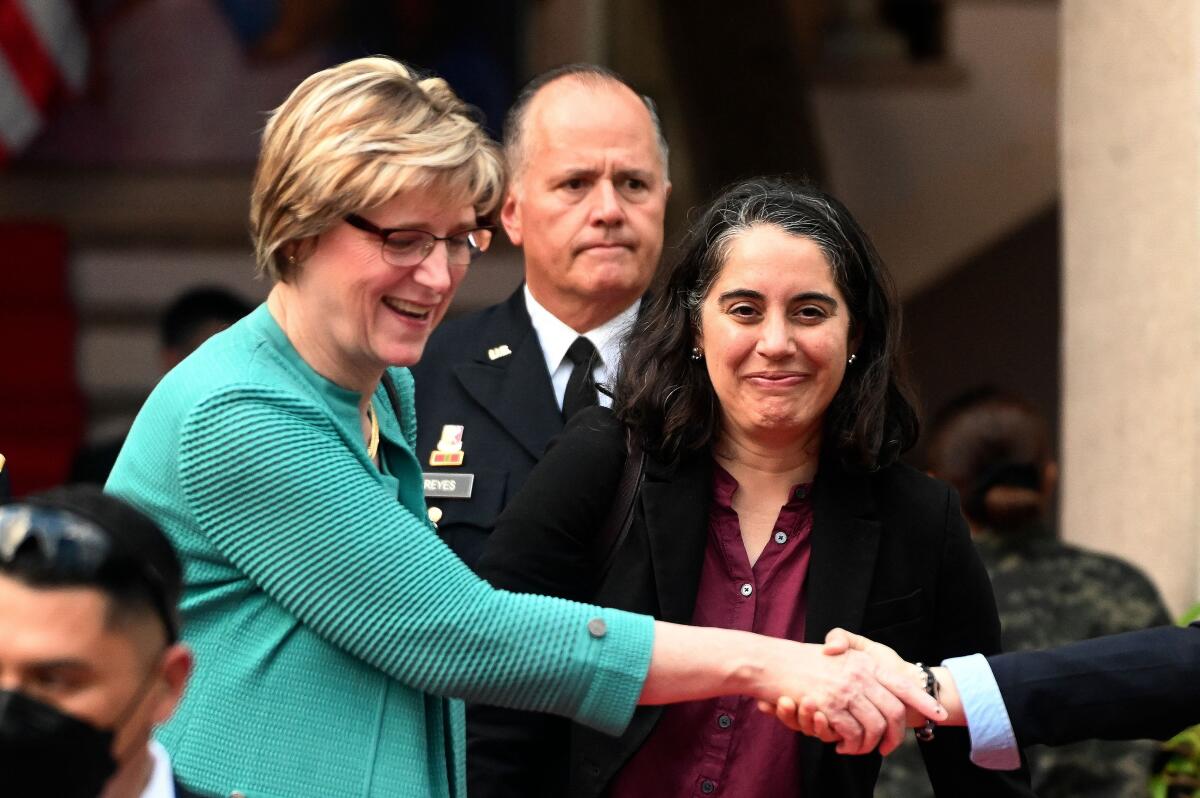
Laura Farnsworth Dogu, left, then ambassador to Honduras, and other U.S. officials leave the presidential palace after a meeting with Honduran President Xiomara Castro in Tegucigalpa on Nov. 4, 2022.
(Orlando Sierra / AFP/Getty Images)
By
Yamlek Mojica Loaisiga
Feb. 4, 2026
3 AM PT
9 min
Click here to listen to this article
Share via
Close extra sharing options
Email Facebook X LinkedIn Threads Reddit WhatsAppCopy Link URL
Copied!
0:00
0:00
1x
This is read by an automated voice. Please report any issues or inconsistencies here.
Career diplomat Laura Farnsworth Dogu has arrived in Venezuela as Trump’s envoy, an unusual pick signaling a strategic shift in U.S. policy following the ouster of Nicolás Maduro.
Dogu served as an ambassador under Presidents Obama and Biden and navigated crises in Nicaragua and Honduras.
Her methodical approach and deep Latin American expertise position her to handle day-to-day diplomacy as Washington recalibrates its relationship with Caracas.
Laura Farnsworth Dogu is not, at first glance, your typical Trump appointee.
A career diplomat with postings under the Obama and Biden administrations, she represents a branch of government President Trump has cut back and long vilified.
Yet her selection for Trump’s top envoy to Venezuela signals a rare strategic choice, leveraging her experience with authoritarian regimes at a moment when Washington is recalibrating its approach to Caracas after the overthrow of Nicolás Maduro.
“There are not very many cases in this administration where they have relied on a career diplomat,” says Elliott Abrams, who served as Trump’s special representative for Venezuela in 2019. “This is actually an anomaly.”
Advertisement
Abrams suggests the appointment of Dogu — who met with the interim president, Delcy Rodríguez, in Caracas on Monday — could reflect a desire for a seasoned expert to manage day-to-day diplomacy as the administration embarks on one of its most complex foreign policy undertakings.
“What he really needs is a professional to oversee the embassy and do the traditional diplomatic things while all policy is made in Washington,” Abrams said, referring to Secretary of State Marco Rubio.
 Trump’s promise of prosperity clashes with harsh reality in Caracas
Nicolás Maduro is gone, but daily life in Venezuela remains grim: Soaring prices, stagnant wages and deep inequality leave families struggling to afford food.
Jan. 30, 2026
Dogu, 62, arrived in Venezuela on Saturday to reopen the U.S. Embassy. She is recognized in Central America for her methodical, approachable style and deep understanding of Latin America’s political and cultural dynamics. However, her direct and outspoken approach has also led to controversy, with enraged officials in Honduras once wanting to declare her persona non grata.
Advertisement
Her new position as chargé d’affaires augments a career that includes senior roles in hostage recovery for the FBI and as ambassador to Nicaragua and Honduras during periods characterized by social and political volatility.
Before taking on her new position, she served as the foreign policy advisor to Gen. Dan Caine, the chairman of the Joint Chiefs of Staff and the leader of the operation that targeted Maduro. Her office did not respond to a request for interview.
Her experience navigating authoritarian governments and fragmented opposition movements makes her a pragmatic choice for a volatile post-Maduro transition. In a Senate hearing on Jan. 28, Rubio stressed the post’s importance for restoring a limited U.S. mission to gather intelligence and engage with Venezuelan stakeholders.
Dogu will be tasked with navigating Venezuela’s fractured opposition, which includes leaders inside the country, exiles abroad and figures struggling for influence in a potential transition. Abrams, the veteran diplomat, said engaging opposition actors, such as Maria Corina Machado, is a core diplomatic responsibility, particularly in a country the United States does not recognize as having a legitimate government. At the same time, maintaining relations with the turbulent, divided government will be her responsibility as well.
Abrams also cautioned that Washington priorities will define Dogu’s mission, and those priorities might not always align neatly with democratic objectives.
“The question is how the administration defines the interests of the United States,” Abrams said. “Does it include a free and democratic Venezuela? I don’t think we really know the answer yet.”
Advertisement
A family ethos of public service
A Texas resident and the daughter of a career Navy officer, Dogu often traces her commitment to public service to her upbringing in a military family. That ethos shaped her diplomatic career and has been a defining thread across generations, with both of her sons also serving in the military.
She has received multiple State Department honors, speaks Spanish, Turkish and Arabic and served in Mexico, El Salvador, Egypt, Turkey and Morocco.
Diplomatic relations between the U.S. and Venezuela have been suspended since 2019. She takes over from John McNamara, who had served as chargé d’affaires since February 2025 and traveled to Venezuela in January to discuss the potential reopening of the embassy.
 How Delcy Rodríguez courted Donald Trump and rose to power in Venezuela
Delcy Rodríguez, Venezuela’s interim president, has risen to prominence through strategic moves and political savvy.
Jan. 7, 2026
According to a statement, Venezuelan Foreign Minister Yván Gil Pinto, indicated that the two governments will hold discussions to establish a “roadmap on matters of bilateral interest” and resolve disagreements through mutual respect and diplomatic dialogue.
Dogu is no stranger to Venezuelan issues. During a 2024 news conference, while serving as ambassador to Honduras, she publicly criticized the participation of sanctioned Venezuelan officials in Honduran government events.
“It’s surprising for me to see [Honduran] government officials sitting with members of a cartel based in Venezuela,” Dogu said at the time, referring to a meeting between the government of President Xiomara Castro and Venezuela’s defense minister, Vladimir Padrino López.
Advertisement
The United States has accused Padrino López of involvement in a conspiracy to distribute cocaine, and there is a $15-million reward for information resulting in his arrest or conviction.
Years earlier, Dogu had offered a blunt assessment of Venezuela’s economic collapse. Speaking in 2019 at Indiana University’s Latin American Studies program, she described Venezuela as “a very wealthy country, [with] huge oil supplies, but they’ve managed to drive their economy into the ground,” the Indiana Gazette reported.
Crisis and confrontations
Nominated by President Obama to serve as ambassador to Nicaragua in 2015, she said at her confirmation hearing that Obama had “rightly maintained” that “no system of government can or should be imposed upon one nation by another.” She added: “America does not presume to know what is best for everyone, just as we would not presume to pick the outcome of a peaceful election.”
Dogu left her Nicaragua post in October 2018 amid nationwide protests and a severe government crackdown that resulted in at least 355 deaths, according to the Inter-American Commission on Human Rights. At the time, Dogu said she learned from authorities that paramilitary groups had targeted her for death.
In 2019, she linked the unrest in Nicaragua to the Cold War, citing an “unfortunate negative synergy” among Nicaragua, Cuba and Venezuela. “We never left the Cold War in Latin America,” she said.
Nicaraguan opposition figures, many now exiled, remember Dogu as an accessible diplomat. Former presidential candidate Juan Sebastián Chamorro called her a “methodical and approachable official” who upheld State Department policy and democratic principles.
Advertisement
Lesther Alemán, then a student leader who frequently interacted with Dogu during the 2018 protests, described her as publicly blunt but privately empathetic. Alemán emphasized Dogu’s ability to engage “all sides of the coin,” making her effective with both the “authoritarian governments and with the opposition.”
 ‘We just want our lives back.’ Maduro’s gone, but what’s next for 8 million Venezuelans who fled?
Nicolás Maduro’s downfall has stirred a mix of relief, fear and uncertainty among Venezuela’s vast diaspora, many of whom were forced into exile by repression and hardship and now face the question of whether they could ever return.
Jan. 12, 2026
Alemán said Dogu initially had a good relationship with the Nicaraguan government, including a personal friendship with then-first lady and current co-President Rosario Murillo. However, that relationship soured after Dogu publicly supported opposition groups during the political crisis.
Her experience in Honduras proved more contentious. After Dogu made her statements regarding Venezuela, Rasel Tomé, vice president of the National Congress and a senior figure in the governing Liberty and Refoundation Party, urged lawmakers to declare her “persona non grata.”
Tomé justified this request by accusing her of making “interventionist statements” directed at the government.
 Venezuelan ‘Chavismo’ revolutionized Latin America. Will it survive Maduro’s fall?
After the U.S. toppled Nicolás Maduro, Venezuela’s new leader bows to Washington, raising doubts about whether the once-defiant Chavista revolution can survive.
Jan. 19, 2026
Criticism continued after Dogu’s departure from Honduras in 2025. An opinion column published by the Committee of Relatives of the Disappeared in Honduras argued that her relationship with the country had been marked by distrust.
“Although Ambassador Laura Dogu makes an effort to say goodbye amicably,” the piece read, “we all know that the relationship between her and Honduras was not sincere because it was disrespectful; it was not trustworthy because it was interventionist.”
Advertisement
This week, the U.S. Embassy posted online an upbeat video of showing Dogu entering the mission, meeting with Venezuelans and outlining plans for what she calls a “friendly, stable, prosperous and democratic” Venezuela. “Our presence marks a new chapter,” she says, “and I’m ready to get to work.”
Mojica Loaisiga is a special correspondent writing for The Times under the auspices of the International Center for Journalists.
More to Read
 U.S. representative arrives in Venezuela to reopen diplomatic mission after 7 years
Feb. 1, 2026
 Venezuelan opposition leader is confident about return of democracy but says little of her plans
Jan. 16, 2026
 DEA has long suspected Venezuelan leader Delcy Rodríguez of ties to drug trade, documents show
Jan. 17, 2026